
First time

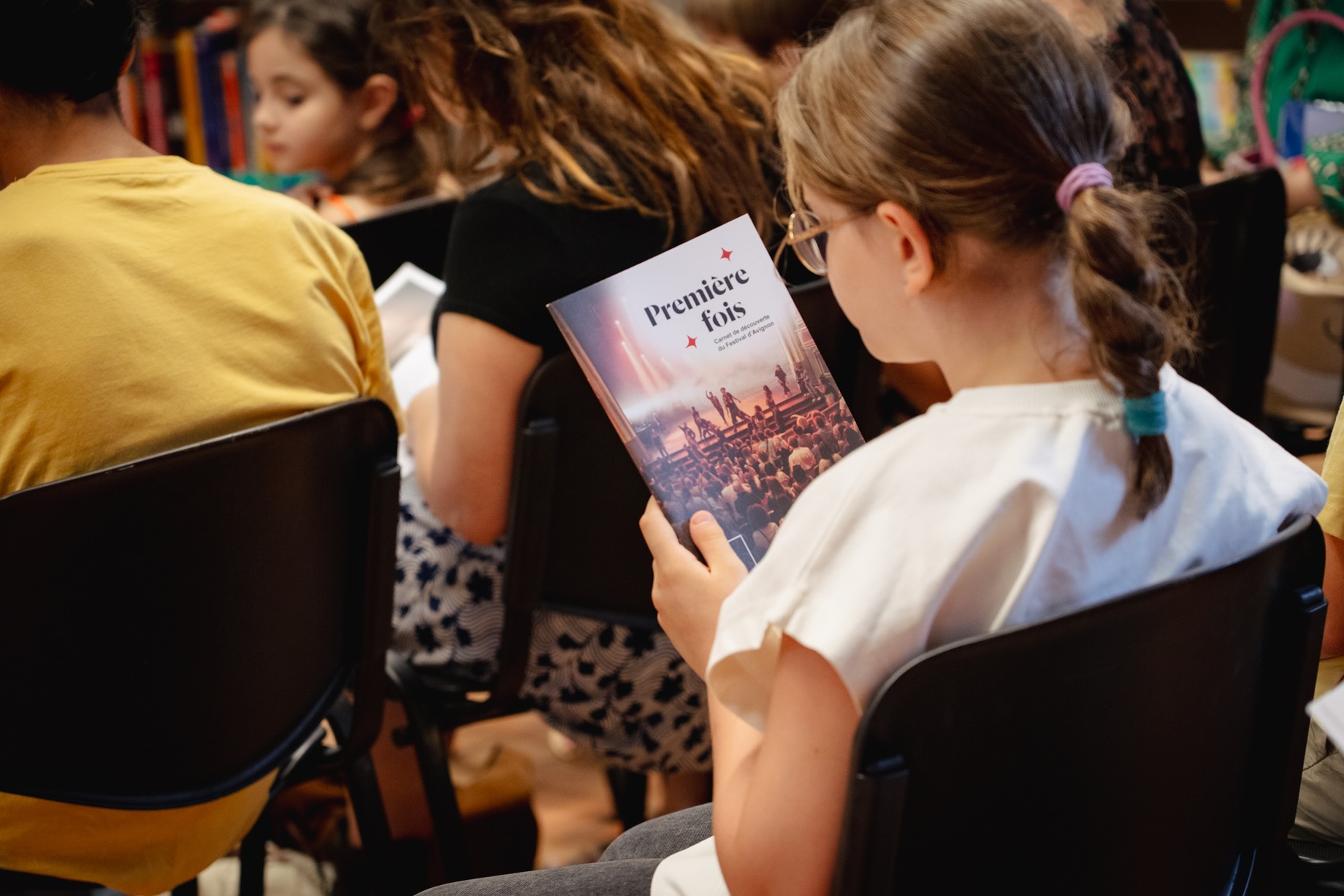
Carnet Première fois © Sacha Blanchard

How to come?
How to choose?
How to prepare?
 

Who remembers their first time at the Festival d’Avignon as an unforgettable experience? To make this adventure accessible to as many people as possible, regardless of age, the Festival and its partners are committed to supporting first-time attendees: by helping them booking transportation and accommodations, facilitating access to performances, and creating forms of mediation that enable them to take part in discussions and fully find their place within the Festival.   

Aimed at individuals, school groups, and social and healthcare organisations, the “Première fois” programme allows participants to discover a variety of artistic works, go behind the scenes, meet artists, take part in hands-on workshops, and visit emblematic venues, each of these activities serving as a gateway to experiencing the Festival. Cultural initiatives further enrich these introductory journeys, such as Making Waves Avignon, Jeunes reporters culture, and J’y suis, j’en suis, in partnership with the Ceméa – Centres de jeunes et de séjours du Festival d’Avignon (CDJSFA).  

An exploration booklet, specially designed for first-time attendees, invites readers to dive into the Festival’s history and discover the performances that have shaped it. Accounts of these first experiences can be found on the Festival’s website and social media. 

Discover shows accessible for a first experience

MAIF, committed to making culture accessible to everyone.

MAIF, the leading insurer for associations, has always championed access to culture for all, an essential pillar of equal opportunities. Through our support for MAIF, committed to making culture accessible to everyone.

MAIF, the leading insurer for associations, has always championed access to culture for all, an essential pillar of equal opportunities. Through our support for the Festival d'Avignon, this commitment is reflected in particular in the “Première fois” scheme, which enables nearly 9,000 people each year to discover the festival’s history and performances.

We also support the eco-responsible approach taken by the Festival d'Avignon, convinced that access to culture must be achieved whilst respecting the environment.

By supporting these initiatives, MAIF reaffirms its mission: to reduce inequalities in access to culture across all regions, whilst encouraging sustainable cultural practices. This commitment is reflected in particular through the “Première fois” scheme, which enables nearly 9,000 people each year to discover the history and performances of the festival.

We also support the eco-friendly approach taken by the Avignon Festival, convinced that access to culture must be achieved with respect for the environment.

Go to the website

The "Première fois" notebook

The Festival d’Avignon is a great celebration that showcases performances from all around the world. It is present in the city all year round, offering workshops, encounters and performances for the people of Avignon. In July, it opens up to the world: the streets come alive, artists share their creations, and Avignon moves to the rhythm of the performing arts.

This booklet helps you discover the Festival d’Avignon: its history, its venues, its values, and its performances. It invites you to experience the Festival at your own pace and to feel free and in your place. It also opens the doors to La FabricA, the Festival’s permanent venue.

Spectators coming to the Festival d’Avignon for the first time have rights, just like those who return year after year. Like all rights, they must be exercised so as not to be lost. The list below is not complete, you can invent new ones by adding the rights that seem important to you.

The following list is by no means complete — it is always a work in progress.

The right not to know the artists of the performance you are about to see

The right to laugh and/or cry during the performance

The right to be bored and even to fall asleep (without snoring!)

The right to imagine that the play was made especially for you

The right to have doubts and questions during and after the play

The right to applaud at the end, in your own rhythm

The right to leave before the end (even if sometimes it’s only at the end that we discover we love a play)

The right not to like the play (even when most of the audience does)

The right not to know whether you liked the play or not, and not feel obliged to decide

The right to love the play and come back to see it a second time

Tiago Rodrigues, inspired by Daniel Pennac, “The Inalienable Rights of the Reader” from Comme un roman, Paris, Gallimard, “Folio” collection, 1992.