
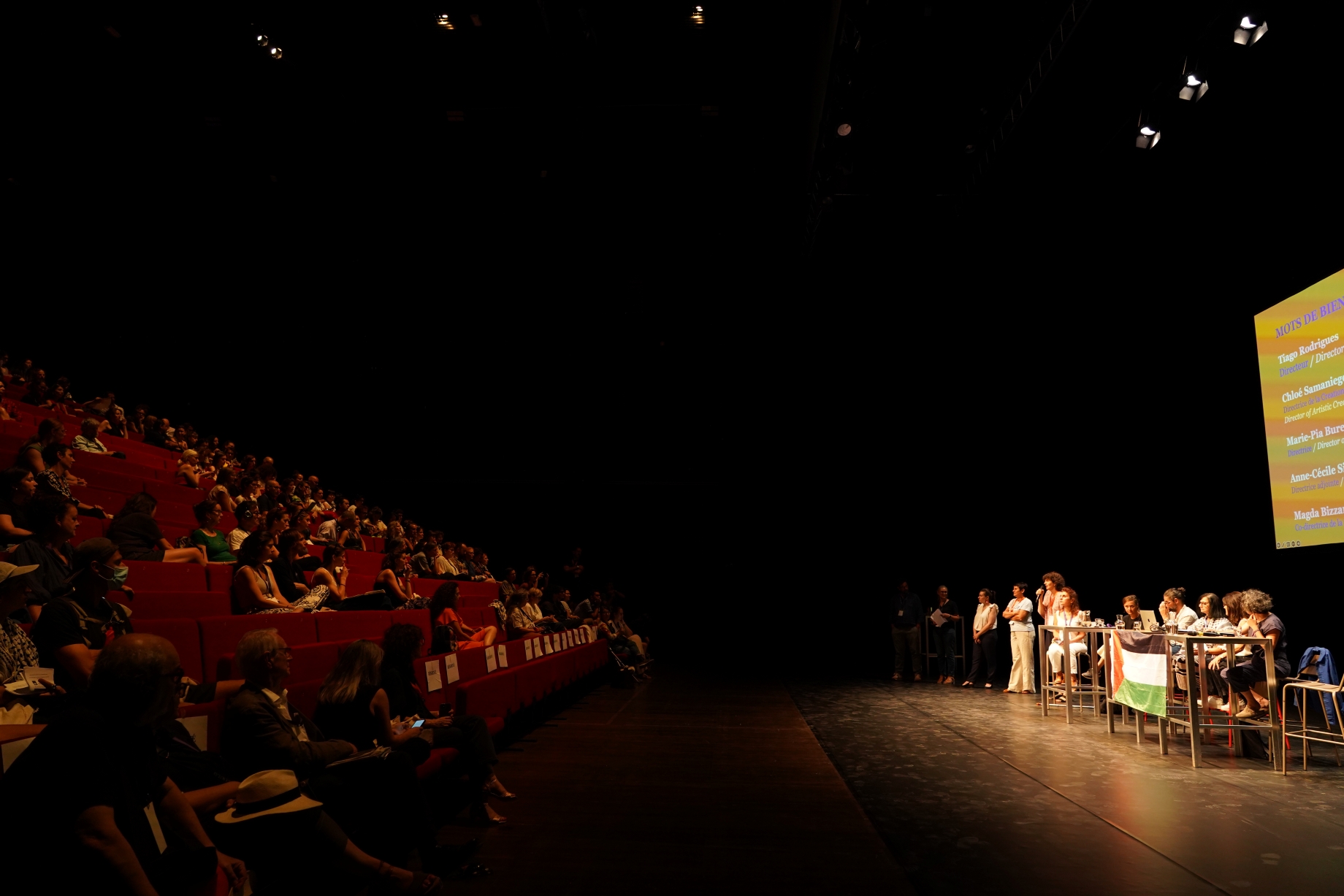
On the occasion of the annual meeting of Onda’s partners, the Festival d’Avignon, the Institut français, and Onda join forces to offer a space for exchange that brings together international festivals and theatres of different scales, rooted in diverse contexts and coming from several continents. This meeting continues the discussions initiated during the two preceding editions.
An inflatable frog in front of ICE troops in Portland: such seems to be the position of the artist today. A figure of resistance facing the horrors of the world as it undergoes democratic, environmental and geopolitical crises, the artist is also supposed to be a source of invention, preserving the autonomy of art as well as their freedom, and this while standing next to all good causes. This is the "impossible place" philosopher Walter Benjamin diagnosed in 1934.
The artist must also negotiate local anchoring and international touring, juggle multiple identities and senses of belonging, and deal with the agendas of theatres and festivals which are often opaque, not to say extractivist. An emblem of awakening, that old Romantic idea, the artist is also at the forefront of capitalism's labour flexibility as it violently pivots. What can we do?
In this panel we will interrogate possible paths for contemporary art-making. Can dialogue and collaboration, as difficult as they are necessary, weave a truly collective intelligence that undermines the so-called artificial one, always ready-to-wear?
Distribution
With Daria Deflorian, director of Che dolore terribile è l'amore; Vanasay Khamphommala, creator and performer of Songs of Grief and Je te chante une chanson toute nue en échange d’un verre; Sasapin Siriwanij, Artistic Director of the Bangkok International Performing Arts Meeting (BIPAM); and Aristide Tarnagda, playwright and artistic collaborator on Étienne Minoungou’s L'Intraitable Beauté du monde
Facilitated by Francisco Frazão, curateur, programmateur (Portugal)
Organised by Festival d’Avignon, Onda, Institut français
With the support Institut français of Thaïlande, the mobility department of LABA and programme Erasmus+.
Presentations
Francisco Frazão is a programmer and translator based in Lisbon. He was artistic director of Teatro do Bairro Alto, a municipal theatre devoted to experimentation in the performing arts. Between 2004 and 2017, he was the theatre programmer at Culturgest, where he also directed PANOS, a project of new writing for youth theatres. He was in company Artistas Unidos’ reading committee, as well as a member of selecting panels in the Film and Audiovisual Institute and in PT, a performing arts showcase organized by Espaço do Tempo. In Ireland, he was a mentor at the MAKE residency ((Performing Arts Forum, Cork Midsummer Festival, Dublin Fringe, Project Arts Centre). He has translated, among others, Beckett, Pinter, Tim Crouch, Tim Etchells, Annie Baker, and Zinnie Harris.
Daria Deflorian is an actress, author, and director. From 2008 to 2021, she co-created with Antonio Tagliarini a series of performances presented across Europe and awarded several prizes, including the 2014 Ubu Prize for Best Text and the 2015 Prize for Best Foreign Performance in Canada. Among her recent solo creations are Elogio della vita a rovescio (2023) and La vegetariana (2024), an adaptation of Han Kang’s novel—2024 Nobel Prize in Literature—which received seven nominations at the 2025 Ubu Awards, winning Best Set Design and Best Lighting. She is an associate artist at the Piccolo Teatro in Milan for the 2025–2028 period.
Vanasay Khamphommala (ວັນນະໄຊ ຄຳພົມມາລາ) is a playwright, performer, author, and translator. She first trained as a singer, before studying English and theatre (École normale supérieure, Harvard, Oxford) and training as an actress. Since 2018, she has been creating performances which include L’Invocation à la muse (Festival d’Avignon 2018 as part of Sujet à vif), Écho, or ສຽງຂອງຍ່າ (La Voix de ma grand-mère). She is currently in residency at the Villa Medici for a project around the myth of Ganymede.
Sasapin Siriwanij is a performing arts producer, curator, and artist based in Bangkok. She holds both Bachelor's and Master's degrees in English from the Faculty of Arts at Chulalongkorn University. Her artistic and curatorial practices focus on the body, personal empowerment, authentic connections, social critique, and societal transformation. Since 2018, she has served as the Artistic Director of the Bangkok International Performing Arts Meeting (BIPAM), while actively pursuing an artistic and producing career in both Thailand and internationally.
Aristide Tarnagda is a Burkinabè actor, playwright and director. Since 2016, he has been the artistic director of Les Récréâtrales. After joining Théâtre de la Fraternité in 2004, he founded his own company, Compagnie Théâtre Acclamations. He was invited to the Festival d'Avignon in 2013 with Et si je les tuais tous, madame ? and returned in 2017 with Sank ou la patience des morts. He received the Grand Prix Littéraire d'Afrique Noire for Terre Rouge and Façons d’aimer. In 2018 and 2020, he continued his exploration of the work of Sinzo Aanza, directing Que ta volonté soit kin, presented at the Odéon Théâtre de l'Europe, and Plaidoirie pour le Congo at the 11th edition of Les Récréâtrales. In 2021, he launched the cultural project TERRE CEINTE, adapted from the novel by Mohamed Mbougar Sarr, and led artistic workshops with internally displaced people in regions affected by terrorism. The production was presented at the 12th edition of Les Récréâtrales in 2022. That same year, he directed an adaptation of Shakespeare's Romeo and Juliet, bringing together professional actors, young amateur performers and internally displaced people. Author of around twenty plays, he initiated the educational project Repères in 2023, touring productions inspired by Joseph Ki-Zerbo, Norbert Zongo and Thomas Sankara to engage students across Burkina Faso. His latest play, Fadhila, was published by Actes Sud-Papiers.