
(Eco)responsible and united

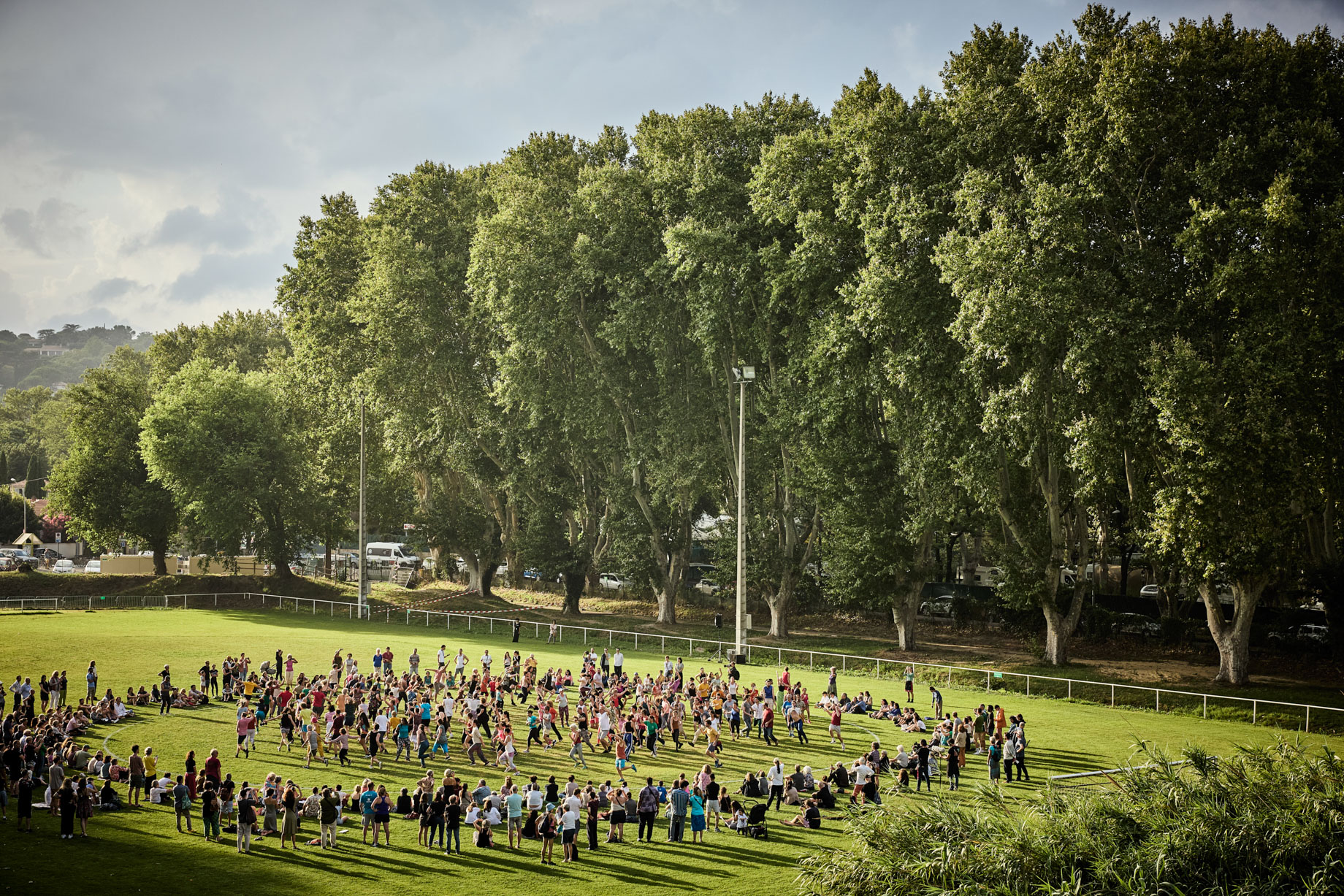
CERCLES, Boris Charmatz, 2024 © Christophe Raynaud de Lage / Festival d'Avignon

New practices and sustainables actions

Since 2010, the Festival d'Avignon has been engaged in an in-depth reflection on its impact and practices in terms of Corporate Social Responsibility (CSR).

In the face of the climate emergency, the aim is to continue to develop new skills, invest in innovative solutions and increase the number of large-scale actions to encourage and support new collective practices. This is why the Festival d'Avignon has set up an internal, collective and cross-disciplinary working group, tasked with implementing sustainable action.

The team is committed to carrying out eco-responsible actions to reduce its carbon impact, continue its ecological transition and make La FabricA, the Festival d'Avignon's permanent venue, a symbol of its entire environmental and societal policy.

A founding member of the Collectif des Festivals Écoresponsables et Solidaires en Région Sud (COFEES), the Festival is a signatory of the Eco-Festival charter in collaboration with the City of Avignon, the Grand Avignon and AF&C, and of the ‘Drastic On Plastic’ charter for the elimination of single-use plastic at cultural events. 

« Corporate social responsibility (CSR) is a concept that has corporations incorporate social, environmental and economic preoccupations in their activities and their interactions with their stakeholders on a voluntary basis. By adopting more ethical and sustainable practices in their operating methods, they aim to contribute to the betterment of society and to the protection of the environment. In other words, it is “a company’s contribution to the challenges of sustainable development. »

Source : ecologie.gouv.fr

MAIF, committed to making culture accessible to everyone.

MAIF, the leading insurer for associations, has always championed access to culture for all, an essential pillar of equal opportunities. Through our support for MAIF, committed to making culture accessible to everyone.

MAIF, the leading insurer for associations, has always championed access to culture for all, an essential pillar of equal opportunities. Through our support for the Festival d'Avignon, this commitment is reflected in particular in the “Première fois” scheme, which enables nearly 9,000 people each year to discover the festival’s history and performances.

We also support the eco-responsible approach taken by the Festival d'Avignon, convinced that access to culture must be achieved whilst respecting the environment.

By supporting these initiatives, MAIF reaffirms its mission: to reduce inequalities in access to culture across all regions, whilst encouraging sustainable cultural practices. This commitment is reflected in particular through the “Première fois” scheme, which enables nearly 9,000 people each year to discover the history and performances of the festival.

We also support the eco-friendly approach taken by the Avignon Festival, convinced that access to culture must be achieved with respect for the environment.

Go to the website

Fields of action

Since 2010, the Festival d’Avignon has been implementing eco-responsible and solidarity-based initiatives aimed at reducing its carbon footprint, furthering its ecological transition, promoting social inclusion, and making La FabricA a symbol of its environmental and societal policy.

A CSR (Corporate Social Responsibility) committee brings together representatives from all departments each month to develop skills, foster innovation, and implement sustainable actions. Its goal: to guide staff, artists, professionals, and audiences toward new responsible and civic-minded practices.

The 2026–2030 Roadmap outlines concrete initiatives implemented since 2020 and development prospects looking ahead to 2030, structured around 10 commitments.

VIEW THE 2026–2030 ROADMAP

  • Transition from an annual roadmap to a multi-year roadmap through 2030

  • Integration of the “Transitions en scènes” pact into the Association’s multi-year objectives agreement

  • Seeking dedicated funding

  • Formalisation of a CSR report with indicators

  • Integration of CSR clauses into the Association’s contracts and agreements

  • Creation of a working group on adaptation to climate change

  • Participation in the revision of the safeguarding and enhancement plan by the City of Avignon’s Remarkable Heritage department

  • Contribution to the development of the heat island master plan by the City of Avignon’s Resilient Urban Planning department

  • Collaboration with the Geomatics Department of Avignon Université to conduct thermal analysis of the Festival d’Avignon’s operating venues

  • Presidency of COFEES (Collective of Eco-Responsible and Solidarity Festivals of the Sud Region) since 2023

The Festival is committed to rethinking its equipment and promoting the use of environmentally friendly transportation.

Transport of sets and equipment

  • Promote rail freight over road freight for the transport of stage sets.

  • Seek to optimise the transport of technical equipment loaned by partner theatres via rail.

Audience transportation

  • Encouraging the use of trains and regional TER services in partnership with the Sud Region and SNCF.

  • Contributing to the improvement of public transport services in coordination with the City of Avignon and Greater Avignon: bicycle storage facilities, Velopop bike-sharing stations, buses, park-and-ride facilities and shuttle services, Festibus, etc.

  • Promoting the use of a carpooling, bike-sharing and ride-sharing platform, in partnership with the Festival Off Avignon.

  • Strengthening communication on low-impact transport options in partnership with Avignon Tourisme.

  • Providing public shuttle buses from Avignon to the Carrière de Boulbon and to L’Autre Scène du Grand Avignon in Vedène.

Transportation of staff and artists

  • Reducing the use of combustion-engine vehicles: providing a fleet of traditional bicycles, electric-assist bicycles (e-bikes), electric cargo bikes, tricycles, a bike trailer, and a fleet of electric vehicles.

  • Adapting infrastructure: installation of charging stations at permanent sites (Cloître Saint-Louis, Eisenhower, La FabricA).

  • Encourage visiting artists to use eco-friendly transportation (train, bus, and bike).

  • Contributing to reforestation initiatives to offset carbon emissions from professional air travel.

  • Participating in experiments with new intermediate vehicles for short-distance travel and deliveries.

  • Implementing a staff mobility plan.

The Festival is pursuing its policy of reducing waste and sorting in line with its activity, at all venues.

  • Improve sorting by strengthening communication on sorting instructions and by optimising the placement of bins, and by making signage more visible

  • Installing cigarette butt collection bins at the various Festival d’Avignon sites

  • Strengthening the responsibilities of the Festival d’Avignon teams involved in waste management

  • Set up shared composting areas in our permanent venues (La FabricA, Cloître Saint-Louis)

  • Reusing or recycling IT equipment at the end of its life cycle

  • Promoting the use of refurbished mobile phones

  • Promoting eco-production, reuse, and recycling of stage sets and costumes

  • Using bio-based paint in the workshops

  • Expanding the use of reusable containers and tableware as a replacement for single-use items

  • Updating indicators to accurately measure waste reduction and sorting performance over the years

  • Raising awareness among the Festival d’Avignon’s suppliers and service providers about waste reduction and sorting through the "Festival d’Avignon Responsible Suppliers Charter" and the "Festival d’Avignon Sustainable Catering Providers Charter"

The Festival is deploying measures to optimise and reduce its energy consumption.

  • Continue improving the energy insulation of buildings made available to the Festival by the City of Avignon, through coordinated efforts

  • Continue the transition to LED lighting

  • Maintain the supply of green electricity and optimise electricity consumption at La FabricA and in all temporary venues

  • Install photovoltaic panels at La FabricA

  • Reduce water consumption by building additional dry toilets and training teams in organic waste recovery systems

  • Improve battery storage conditions to extend their lifespan and increase safety

  • Write CSR sections into venue technical sheets to structure the transfer of responsible practices for site operations

Whether it’s about reducing high-ecological-footprint merchandise or, more generally, prioritising the circular economy and short supply chains, the Festival is strengthening its responsible purchasing policy.

  • Selecting responsible suppliers and service providers in line with CSR charters: favouring short supply chains, organic products where possible, and respect for human rights in particular

  • Promoting the purchase of raw materials and products that are environmentally and health-friendly

  • Sharing CSR charters with suppliers when placing orders

  • Ensuring regular monitoring and analysis of the existing indicator framework in order to improve practices

Mindful food ans catering

  • Offer more vegetarian menus for receptions

  • Continue using large containers for the bar

  • Promote the purchase of products through short supply chains by developing relationships with local and organic producers

  • Highlight local and organic products in social gathering places

Merchandise

  • Continue ethical purchasing in accordance with the suppliers' charter

  • Change our gift policy for professionals toward a more modest approach

A series of reflections are underway to adopt a more sustainable communication approach, incorporating digital sobriety.

  • Communicate about good digital practices

  • Limit the quantity of printed communication materials

  • Reduce postal mailings by optimising the mailing list

  • Encourage recipients to update their mailing preferences

  • Improve the distribution and allocation of press materials across Festival venues

  • Optimise storage methods to reduce internal transport during the distribution of printed publications

  • Optimise the digital footprint of the website and app

  • Improve accessibility and develop Easy-to-Read and Understand (FALC) content for the website and printed materials

  • Conduct an “accessibility” audit of the Festival d’Avignon website

  • Consider hosting Festival d’Avignon data in a local “green” data center

  • Explore ethical and responsible digital solutions

By sharing its values and goals, the Festival encourages active participation from everyone with the aim of preserving the environment and promoting an ethical and fair economy.

  • Rely on structured support with COFEES to strengthen and broaden the impact of the CSR approach

  • Improve the visibility of the Festival’s commitments: dedicated communication plan, dissemination of the multi-year strategy and the multi-year roadmap

  • Strengthen the internal embedding of CSR through speaking engagements, the identification of designated referent persons per department, monitoring of indicators, integration of a CSR clause into employment contracts, welcome booklets, internal procedure manuals, and technical sheets for venues

  • Identify CSR training needs and train venue staff in eco-responsible practices

  • Communicate CSR commitments to performing companies: integration of a CSR clause into performance contracts, welcome booklets, and display of the artistic teams’ welcome charter across all venues

  • Participate in professional meetings to improve eco-responsible practices: COFEES, ARVIVA, Arsud, MAIF Culture, We Count, etc.

  • Co-develop, in partnership with Avignon Tourisme and the Festival Off Avignon, a booklet on eco-responsible practices for audiences

  • Collaborate with public authorities in the fight against sexist, sexual, and moral violence and harassment (VHSSM), and take part in awareness-raising and prevention initiatives

The Festival continues its efforts to improve accessibility to venues and performances, as well as to better include people with disabilities in careers in the performing arts.

  • Improve the accessibility of the website for people with visual or cognitive impairments

  • Systematically update and maintain venue information sheets on the website (in the “Access” section)

  • Train teams in welcoming audiences, staff, and artists with disabilities

  • Provide wheelchairs and accessible toilets for people with reduced mobility (PRM) at certain Festival venues in Avignon (Cour d’honneur, La FabricA, Carrière de Boulbon)

  • Include performances in the programme that give visibility to artists with disabilities

  • Provide vibrating vests for deaf and hard-of-hearing audiences at performances involving amplified music

  • Promote the employment of people with disabilities through detailed job postings, distribution via specialized employment networks (Cap Emploi), and the organisation of a dedicated recruitment day (the annual employment day for people with disabilities at La FabricA)

  • Present Festival venues in Avignon to visually impaired and blind audiences using tactile models during workshops

By embracing the integration of all forms of diversity, the Festival affirms its commitment to inclusion.

  • Ensure gender parity in programming

  • Continue the internal “Equal Professional Opportunity” plan promoting the principles of non-discrimination, regardless of gender, origin, age, or employee health status

  • Inform and disseminate the internal protocol for preventing and addressing sexist, sexual, and moral violence and harassment (VHSSM)

  • Train Festival teams on CSR issues, disability inclusion, prevention of VHSSM, and addiction risks

  • Continue the “Recommended Jobs” schemes (allowing social-sector partners and the employment platform to propose candidates for seasonal jobs)

  • Organise each year the Employment Fair for people with disabilities at La FabricA

  • Ensure career monitoring and the prevention of health issues, and organise medical follow-up through occupational health services

  • Maintain a “Prevention of harassment, ethics and good conduct” clause in employment contracts

  • Communicate principles of respect and equality to be upheld within the organisation through staff welcome booklets, display of

    the artistic teams’ welcome charter across all venues, dedicated posters on preventing VHSSM (sexist, sexual, and moral violence and harassment), and sharing the contact details of designated referents responsible for addressing VHSSM

  • Draft a charter for festival-goers to help prevent verbal and physical violence against the Festival d’Avignon teams

In response to the climate emergency, the Festival is committed to protecting the environment and local biodiversity.

  • Preserve the Carrière de Boulbon site: carry out brush clearing, establish a pathway serving as a firebreak, and maintain collaboration with the National Forestry Office to protect local plant species

  • Promote an artistic programme with a deep commitment, environmentally conscious, and respectful of ecosystems

  • Monitor studies on the environmental impact of performing arts activities, particularly outdoor performances

  • Contribute to the planting of a Festival forest in partnership with the City of Avignon

  • Install a beehive at La FabricA to support the preservation of bees

  • Take part in urban planning studies on the development of residential areas in anticipation of climate events (heatwaves and floods), and for climate adaptation (development of soft mobility options, greening and de-sealing of soils, etc.)